


If you're an aerospace OEM sourcing PCB assembly, ISO 9001 certification on its own is disqualifying — not qualifying. AS9100D is the aerospace-industry-specific quality-management standard, built on the ISO 9001:2015 framework but adding more than 100 aerospace-specific requirements: configuration management, counterfeit-parts prevention, foreign-object-debris (FOD) control, product safety, special-process control, and registration in the OASIS supplier database. A contract manufacturer (CM) that holds only ISO 9001 cannot legitimately bid flight hardware, missile electronics, or any program subject to DCMA or FAA airworthiness oversight. This 10-point breakdown walks through exactly what AS9100D adds — and what to verify on the qualification call before placing a PO.
It's structured to be a procurement-engineer screening script: every section maps to a specific AS9100D clause you can ask the CM to walk through during a supplier qualification audit.
Why ISO 9001 is the floor, not the ceiling, for aerospace
ISO 9001:2015 is a general-purpose quality-management framework — applicable to any organization in any industry, from candy bars to circuit boards. It establishes the QMS skeleton: process approach, customer focus, risk-based thinking, continual improvement. AS9100D, published and maintained by the SAE Aerospace Council with the International Aerospace Quality Group (IAQG), inherits every ISO 9001 clause and adds aerospace-specific requirements on top. The aerospace additions reflect lessons learned the hard way over six decades of flight-hardware failures, supplier-fraud cases, and program losses.
Put differently: ISO 9001 certifies that a manufacturer has a quality system. AS9100D certifies that the system is configured for the failure modes that take down aircraft, satellites, and weapon systems. The aerospace primes (Boeing, Lockheed Martin, Northrop Grumman, Raytheon, Airbus) treat AS9100D as a hard supplier-qualification gate — most won't even issue an RFQ to a CM that isn't in OASIS.
The 10 critical differences AS9100D adds — and what to verify
1. What's the actual structural relationship between AS9100D and ISO 9001?
AS9100D contains the entire text of ISO 9001:2015 verbatim, then adds aerospace-specific text either as new clauses (e.g., 8.1.4 "Prevention of Counterfeit Parts," 8.5.1.3 "Production Process Verification") or as additions inside existing clauses. The result: every AS9100D-certified CM is automatically ISO 9001 compliant, but not vice versa. When evaluating a CM, ask for the actual certificate PDF — AS9100D certificates explicitly list both standards in the scope. If they only have ISO 9001, they're at the floor of generic quality; they may still be a good fit for commercial-electronics work, but not for aerospace.
2. What is OASIS, and why does it determine whether a CM can bid your work?
OASIS is the Online Aerospace Supplier Information System — the IAQG-maintained database that lists every AS9100-certified supplier worldwide, along with their current certificate status, scope, certification body, and audit history. Most aerospace primes require their CMs to be active in OASIS as a procurement pre-condition: if you're not in OASIS, you don't get the RFQ. Verify directly at iaqg.org/oasis — search by company name or certificate number, confirm the status is "Certified" (not "Suspended" or "Withdrawn"), and read the scope to ensure it covers PCBA / cable assembly / box build as applicable. A CM that claims AS9100D but isn't findable in OASIS is either pre-certification or has had their certificate pulled.
3. How does AS9100D enforce configuration management beyond ISO 9001?
Clause 8.1.2 of AS9100D requires formal configuration management (CM) — a discipline ISO 9001 only loosely implies. Every revision of a drawing, BOM, work instruction, fixture, and test program must be uniquely identified, controlled, and traceable through the entire product lifecycle. For PCBA, this means: every board built carries traceability back to the specific Gerber revision, BOM revision, stencil revision, reflow profile, and test ATP version used to build it. Ask the CM: "If a flight-hardware nonconformity surfaces 18 months from now, can you tell me exactly which Gerber and BOM revisions built the affected lot?" An AS9100D-certified CM can answer this from the device history record (DHR) in minutes; an ISO-9001-only CM typically cannot.
4. What does AS9100D require for counterfeit-parts prevention?
Clause 8.1.4 — added in Rev C, sharpened in Rev D — mandates a documented counterfeit-electronic-parts prevention process. The CM must operate an approved-vendor list (AVL), source from authorized distributors or franchised channels by default, qualify any broker-sourced parts through inspection and testing (SAE AS6081 is the de-facto methodology), and maintain quarantine procedures for suspect parts. Ask: "Walk me through your AS6081-aligned counterfeit-mitigation process for a sole-source legacy part." A vague answer ("we only buy from authorized distributors") without a written quarantine + test procedure is a Clause 8.1.4 gap.
5. How is risk management different under AS9100D?
ISO 9001 introduces "risk-based thinking" as a philosophy. AS9100D Clause 8.1.1 turns it into a formal operational requirement: identify operational risks, document mitigation actions, monitor effectiveness. For aerospace PCBA, the operational risks the CM must track include single-source components, special-process degradation (oven calibration drift, solder bath contamination), operator turnover on Class 3 lines, and supplier delivery risk. Ask to see their risk register and the mitigation actions tied to the line that would build your board. A real AS9100D shop produces this in 5 minutes; ISO-9001-only shops generally produce a generic "we manage risk" slide.
6. What's the deal with "special processes" under AS9100D Clause 8.5.1.2?
A special process is one whose output cannot be fully verified by post-process inspection — soldering, conformal coating, swaging, crimping, potting, welding. The product looks right, but you can't confirm the process was performed correctly without destructive testing or process validation. AS9100D Clause 8.5.1.2 requires every special process to be qualified, with operators certified to the qualification standard (e.g., IPC J-STD-001 Class 3 for aerospace soldering), parameters monitored, and re-qualification scheduled. Ask: "Which of my board's processes are classified as special, and what's the requalification schedule for each?" An AS9100D shop maintains this register; an ISO-9001-only shop typically does not differentiate.
7. Does AS9100D certification require AS9102 first-article inspection capability?
AS9100D doesn't mandate AS9102 by itself, but virtually every aerospace prime contract flows it down as a customer-specific requirement under Clause 8.5.1.3 (Production Process Verification). AS9102 is the standardized first-article inspection (FAI) report format — every characteristic on the drawing gets verified, measured, and recorded before production runs. For PCBA, AS9102 FAI is non-trivial: it requires correlating the build to the specific Gerber/BOM/stack-up revisions, recording dimensional and electrical measurements, and producing the FAI form set (Forms 1, 2, 3). Ask: "Show me an AS9102 FAI package you've produced for a customer in the last six months." If they hesitate, they're not aerospace-ready.
8. How does AS9100D treat product safety and ethics — and why was that added?
Rev D added Clause 8.1.3 "Product Safety" and Clause 5.1.1 "Ethical Behavior" — both unprecedented in ISO 9001. Product safety requires the CM to identify safety-critical characteristics, control the processes that affect them, and report safety events to the customer. The ethics clause was added in direct response to the counterfeit-parts crisis of the early 2010s, where multiple primes discovered supplier fraud in their flight-hardware supply chain. Ask the CM how they enforce these clauses: there should be a documented product-safety review process and an ethics policy that names specific behaviors (counterfeit avoidance, falsification, conflict-of-interest disclosure). "We have a code of conduct" alone doesn't pass.
9. How are FOD (foreign object debris) requirements enforced?
Foreign-object debris — wire trimmings, solder balls, dropped washers, plastic flash — is one of the most common causes of in-service aerospace electronics failure. AS9100D inherits FOD control from AS9146 and similar industry guidance, requiring documented FOD prevention in every production area. For PCBA, this typically looks like: tool tethering at workstations, clean-as-you-go protocols, screened breakroom-to-floor transitions, FOD-walk inspections at shift changes, and FOD-incident logging. Ask: "Show me your FOD-incident log for the last 90 days." A CM that has zero FOD incidents logged is either pristine (rare) or not tracking. An AS9100D shop tracks even minor incidents because the trend is what flags an emerging process problem.
10. Can a CM be "compliant" with AS9100D without being certified?
No — for any program that flows down AS9100D as a contractual requirement, the CM must be third-party certified by an IAQG-recognized certification body (a list is maintained at iaqg.org). "AS9100D compliant" without certification is a self-claim with no audit standing. Primes and DCMA quality-assurance representatives will not accept a self-attestation in lieu of an OASIS-listed certificate. If a CM tells you they "follow AS9100D principles" but aren't certified, that's a non-starter for flight hardware — full stop. For ground-support equipment or non-flight test hardware, it may be acceptable depending on contract; verify with your program's quality plan.
Red flags during the qualification call
From running this checklist on dozens of aerospace OEMs' supplier-qualification programs, these phrases consistently signal AS9100D gaps:
- "We're AS9100D-equivalent" / "AS9100D-compliant." Equivalence and compliance are self-claims; certification is third-party verified. Demand the OASIS listing.
- "We're working on AS9100D certification." Fine for commercial work; not acceptable for flight hardware until the certificate is issued. Don't bet a program on a pending audit.
- No counterfeit-parts policy in writing. Clause 8.1.4 is mandatory. Vague "we trust our suppliers" answers are a 483-equivalent finding.
- Cannot produce an AS9102 FAI sample on the call. If they've never produced one, they've never delivered to an aerospace prime — period.
- No FOD logging. Either pristine (unlikely at scale) or untracked. Untracked = the next FOD-related field failure has no upstream signal.
- Certificate scope doesn't cover PCBA. Read the scope clause word-for-word. "Design and assembly of aerospace electronics" includes PCBA; "machining and finishing of metallic aerospace components" does not.
How i-TECH e-Services approaches aerospace PCB assembly
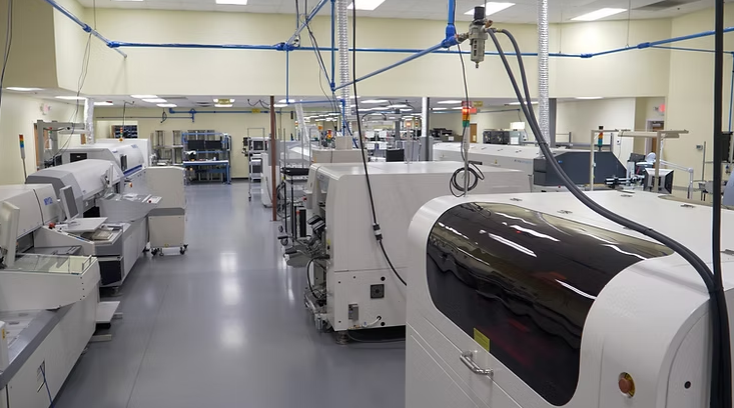
i-TECH e-Services operates an AS9100D and ISO 13485 certified facility in Norcross, Georgia — both certifications backed by accredited-registrar surveillance audits and active OASIS listing. The combined AS9100D + ISO 13485 posture is rare and useful: aerospace-grade configuration management and FOD discipline are applied to every board we build, including medical and industrial work, which raises the quality floor across the entire shop. Practical implications for aerospace OEMs:
- OASIS-listed AS9100D certification with full PCBA, cable assembly, and box-build scope. Verifiable directly at iaqg.org/oasis.
- AS9102 first-article inspection as standard practice on flight-hardware programs, with redacted sample packages available under NDA.
- IPC J-STD-001 Class 3 soldering capability with certified IPC trainers (CITs) and operators on staff. See our quality and testing overview for the full inspection stack (AOI, X-ray, ICT, FCT).
- AS6081-aligned counterfeit-parts mitigation with documented AVL, broker-quarantine procedures, and X-ray inspection of sole-source legacy components.
- U.S.-based operations with ITAR registration for OEMs subject to export-controlled or trusted-foundry program requirements. Details on our aerospace and defense capabilities page.
- Configuration management to the build-document revision across the entire DHR — every board's lot is traceable to the exact Gerber/BOM/stack-up revisions used to assemble it.
If you're vetting an aerospace PCBA partner, our quality team is happy to walk through these 10 questions on a call with your specific program's quality plan in hand, and to send redacted AS9102 and FAI samples under NDA. Request a quote with your project details to start the conversation.
Bottom line
An ISO 9001 certificate proves a CM has a quality system. An AS9100D certificate proves the system is configured for the failure modes that take down flight hardware. For any program subject to aerospace-prime flow-down, DCMA quality oversight, or FAA airworthiness consideration, AS9100D certification is the non-negotiable entry ticket — and OASIS is where you verify it. Use this 10-point breakdown on the next qualification call. The CMs that survive it are the ones who'll still be on your AVL three years from now.