


Turnkey PCB manufacturing combined with in-house SMT capability gives OEMs a single-source partner that handles component sourcing, surface-mount assembly, through-hole insertion, inspection, and functional testing—all within one facility. This consolidation eliminates multi-vendor coordination delays, reduces quality risks from handoff points, and compresses production timelines from weeks to days. For OEMs operating in aerospace, medical, defense, and industrial markets, this model is the fastest path to reliable, repeatable, production-ready electronics.
Key Takeaways
- Turnkey PCB manufacturing means one partner manages the entire build cycle—from bare board procurement and BOM sourcing through assembly, test, and shipment.
- In-house SMT capability keeps surface-mount assembly on-site, giving the manufacturer direct control over solder paste application, component placement, reflow profiling, and AOI inspection.
- OEMs that work with a turnkey partner with in-house SMT reduce lead times by eliminating the coordination overhead of managing multiple subcontractors.
- Quality control improves because every process step—incoming inspection, placement accuracy, solder joint integrity, and functional test—happens under one quality management system.
- This model supports high-reliability programs in aerospace and defense, medical devices, and industrial electronics where traceability and regulatory compliance are non-negotiable.
- Scalability becomes straightforward: the same line that runs your prototype can ramp to production volume without re-qualifying a new vendor.
What Is Turnkey PCB Manufacturing?
Turnkey PCB manufacturing is a service model where a single electronics contract manufacturer takes full ownership of the PCB assembly process—from start to finish. Instead of the OEM purchasing bare boards from one supplier, components from distributors, and then shipping everything to a separate assembly house, a turnkey manufacturer handles all of it.
The scope of a turnkey engagement typically includes:
- Bare board procurement — sourcing PCBs from qualified fabricators based on the OEM's Gerber files and specifications
- Bill of materials (BOM) management — quoting, sourcing, and purchasing all electronic components, managing alternates, and flagging obsolescence risks
- SMT and through-hole assembly — populating the board with components using automated pick-and-place equipment and wave or selective solder systems
- Inspection and testing — automated optical inspection (AOI), X-ray inspection for BGAs and hidden solder joints, in-circuit test (ICT), and functional test
- Conformal coating, potting, and finishing — applying protective coatings for harsh environments
- Final packaging and shipment — delivering tested, labeled, and packaged assemblies ready for integration
The key advantage is accountability. With a turnkey model, there is one purchase order, one quality system, one point of contact, and one schedule to manage. For OEMs building complex products, this simplification is significant. Learn more about i-TECH's turnkey PCB assembly services.
What Is In-House SMT Capability?
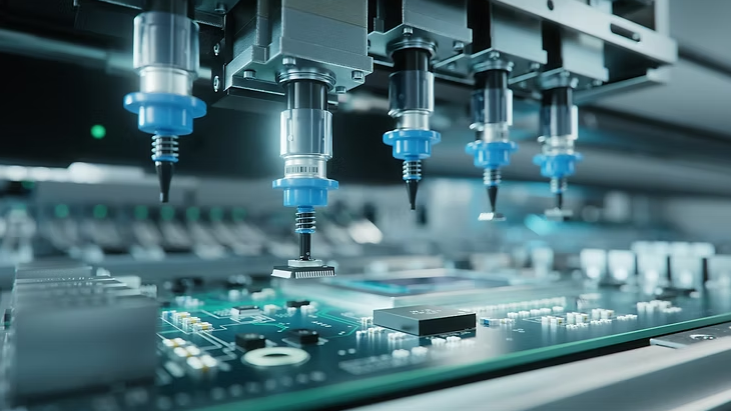
In-house SMT (Surface-Mount Technology) capability means the manufacturer owns and operates its own SMT assembly line on-site rather than subcontracting surface-mount work to a third party. A typical in-house SMT line includes:
- Stencil printer — applies solder paste to the bare PCB through a precision-cut stencil
- Solder paste inspection (SPI) — verifies paste volume, height, and alignment before component placement
- Pick-and-place machines — high-speed automated systems that place surface-mount components (resistors, capacitors, ICs, BGAs, QFNs) onto the solder-pasted board
- Reflow oven — heats the populated board through a carefully profiled thermal cycle to melt the solder paste and form permanent solder joints
- Automated optical inspection (AOI) — post-reflow camera-based inspection that checks for solder bridges, missing components, tombstoning, and misalignment
- X-ray inspection — used for area-array packages (BGA, QFN, LGA) where solder joints are hidden beneath the component body
When SMT capability is in-house, the manufacturer has direct control over every variable: paste chemistry, stencil aperture design, placement accuracy, reflow profiles, and inspection thresholds. This control translates to better first-pass yield, faster defect resolution, and the ability to tune the process for each unique assembly. Explore i-TECH's full manufacturing capabilities including our SMT assembly lines.
Why Do OEMs Prefer a Partner with Both?
When turnkey manufacturing and in-house SMT capability exist under the same roof, OEMs gain a level of integration that is impossible to achieve with a fragmented supply chain. Here is why that matters in practice.
Consider a typical multi-vendor scenario: an OEM buys bare boards from Fab House A, sources components through Distributor B, ships everything to Assembly House C for SMT, then sends the boards to Test House D for functional verification. Each handoff introduces transit time, incoming inspection cycles, communication gaps, and quality risk. If a defect appears at test, resolving it requires reverse-engineering which upstream step caused the issue—often across different companies with different quality systems.
A turnkey partner with in-house SMT collapses this chain. The engineering team that reviews the BOM is the same team that programs the pick-and-place machine. The quality engineers who inspect incoming components also set the AOI thresholds. The test technicians who find a defect can walk to the SMT line and review the reflow profile within minutes. That proximity and integration are the real competitive advantage.
Faster Production and Better Project Coordination
Speed is often the primary driver for OEMs choosing a turnkey PCB manufacturing partner. When one company manages procurement, assembly, and test, the timeline compresses in several ways:
- Parallel processing — BOM sourcing begins while DFM review is underway; bare boards and components arrive coordinated to hit the line together
- No transit gaps — boards do not sit on a loading dock waiting for a truck to the next vendor; they move from SMT to through-hole to test on the same floor
- Single scheduling authority — the production planner controls the entire workflow and can prioritize or re-sequence jobs to meet delivery commitments
- Rapid ECO implementation — engineering change orders flow through one system; the updated BOM, program files, and test procedures are synchronized immediately
For OEMs facing tight launch windows—new product introductions, qualification deadlines, or customer pull-in requests—this speed advantage is not theoretical. It is the difference between meeting a ship date and missing a market window.
Improved Quality Control and Process Consistency
Quality is not an add-on in electronics manufacturing—it is the outcome of a disciplined process executed consistently. Turnkey PCB manufacturing with in-house SMT capability gives the manufacturer end-to-end control over that process, which directly improves quality outcomes.
- Unified quality management system — one set of procedures, one CAPA (Corrective and Preventive Action) system, one audit trail from incoming inspection through final test
- Full traceability — lot codes, date codes, moisture sensitivity levels, and reflow profiles are tracked and linked to every serial number; this is critical for aerospace and medical device programs
- Process consistency — the same operators, the same machines, and the same procedures run every build; this repeatability drives down defect rates over time
- Closed-loop feedback — when a test failure occurs, the root cause analysis feeds directly back to the SMT line; the corrective action is implemented on the next board, not the next lot shipped from a subcontractor
For OEMs in regulated industries, this matters because auditors want to see a clean, traceable thread from raw material to finished product. i-TECH holds AS9100D, ISO 13485, and ITAR registrations—certifications that validate this level of process control.
Supply Chain Visibility and Fewer Vendor Handoffs
Every vendor handoff in a PCB supply chain is a potential failure point. Shipping damage, miscommunication on revisions, incoming inspection discrepancies, and scheduling misalignment all increase with each additional vendor in the chain.
A turnkey PCB manufacturing partner with in-house SMT capability reduces these handoffs to a minimum. The OEM interfaces with one company. That company manages relationships with board fabricators, component distributors, and any specialty process vendors (such as conformal coating or selective soldering) as part of its standard workflow.
Benefits of this consolidation include:
- Reduced risk of counterfeit components — the manufacturer sources from authorized distributors and performs incoming inspection with documented procedures
- Better demand forecasting — the manufacturer sees the full production schedule and can negotiate pricing or secure allocation for long-lead components
- Simplified communication — one project manager, one engineering contact, one quality representative; no multi-party conference calls to resolve a single issue
- Faster issue resolution — if a component is unavailable, the engineering team can evaluate alternates, update the BOM, and adjust the pick-and-place program without waiting for approvals across multiple organizations
OEMs developing new products can also benefit from rapid prototyping services within the same turnkey framework, ensuring a smooth transition from prototype to production.
Better Support for Complex and High-Reliability Builds
Not every PCB assembly is a simple two-layer board with passive components. Many OEM products require complex, high-reliability builds that demand specialized processes and certifications:
- Aerospace and defense electronics — IPC Class 3 workmanship, conformal coating, MIL-spec materials, and full lot traceability per AS9100D requirements. See i-TECH's aerospace and defense manufacturing capabilities.
- Medical device assemblies — ISO 13485-compliant processes, design history file (DHF) support, validated test procedures, and FDA 21 CFR Part 820 alignment. Learn about i-TECH's medical device manufacturing services.
- Industrial and energy systems — ruggedized assemblies for harsh environments, high-current power electronics, and extended temperature range qualification
- Defense communications — ITAR-registered facilities, controlled access, and secure handling of export-controlled technical data
A turnkey manufacturer with in-house SMT can support these requirements because the people, processes, and equipment are all under one roof and one management system. Subcontracting SMT to a shop that does not hold the same certifications introduces compliance risk that no amount of paperwork can fully mitigate.
How This Helps OEMs Scale with Confidence
One of the most overlooked advantages of turnkey PCB manufacturing with in-house SMT capability is scalability. When an OEM qualifies a manufacturing partner at the prototype stage, the same partner should be able to scale to low-volume production, mid-volume production, and eventually high-volume production without a re-qualification event.
This continuity means:
- No re-validation — the process, equipment, and quality system are already qualified; scaling up is a capacity discussion, not a qualification project
- Consistent quality at volume — the same SMT line, the same reflow profiles, and the same inspection criteria apply whether you are building 50 units or 5,000
- Predictable costs — the manufacturer can provide volume-tier pricing because they control the entire supply chain and assembly process
- Production flexibility — the ability to run mixed builds (different products on the same line) without lengthy changeover procedures
For OEMs in growth phases—launching new product lines, entering new markets, or responding to unexpected demand—this scalability removes one of the biggest operational risks: finding and qualifying a new manufacturing partner mid-program.
Frequently Asked Questions
What is the difference between turnkey and consigned PCB assembly?
In turnkey PCB assembly, the manufacturer procures all materials—bare boards, components, and consumables—on behalf of the OEM. In consigned assembly, the OEM purchases and ships the materials to the manufacturer, who only performs assembly and test. Turnkey reduces the OEM's procurement burden and gives the manufacturer better control over material quality and scheduling. Most OEMs prefer turnkey for production volumes because it simplifies logistics and consolidates accountability.
Why does in-house SMT matter compared to outsourced SMT?
When a manufacturer outsources SMT assembly, it loses direct control over solder paste application, placement accuracy, reflow profiling, and post-reflow inspection. In-house SMT capability means the manufacturer can adjust process parameters in real time, respond to defects immediately, and maintain consistent quality across builds. For high-reliability applications in aerospace, medical, and defense, this level of control is often a contractual or regulatory requirement.
What certifications should a turnkey PCB manufacturer hold?
At minimum, look for ISO 9001 for general quality management. For aerospace programs, AS9100D is essential. Medical device assemblies require ISO 13485. Defense work involving export-controlled data requires ITAR registration. Additional certifications like IPC-A-610 (acceptability of electronic assemblies) and J-STD-001 (soldering requirements) demonstrate commitment to industry-standard workmanship. i-TECH holds all of these certifications.
How does turnkey manufacturing reduce lead times?
Turnkey manufacturing reduces lead times by running procurement, DFM review, and production planning in parallel rather than sequentially. The manufacturer begins sourcing components while reviewing design files, coordinates bare board delivery with component arrivals, and eliminates transit time between vendors. The result is a compressed timeline from purchase order to shipment—often measured in days rather than weeks for standard builds.
Can a turnkey manufacturer handle both prototypes and production runs?
Yes. A capable turnkey manufacturer with in-house SMT can build prototype quantities (as few as one board) and scale to production volumes on the same equipment. This is a significant advantage because it eliminates the need to re-qualify a different manufacturer when transitioning from prototype to production. The process, materials, and quality system remain constant, which reduces risk and accelerates time to market. i-TECH offers rapid prototyping that transitions seamlessly into full production.
What industries benefit most from turnkey PCB manufacturing with in-house SMT?
Industries with complex regulatory requirements, high-reliability standards, and compressed timelines benefit the most. These include aerospace and defense (AS9100D, ITAR), medical devices (ISO 13485, FDA compliance), industrial electronics (ruggedized designs, harsh environments), and energy and utility systems (power electronics, grid infrastructure). In all of these sectors, having one qualified partner manage the full build cycle reduces compliance risk and improves time-to-market.
Partner with i-TECH for Turnkey PCB Manufacturing
i-TECH e-Services is a U.S.-based electronics contract manufacturer with in-house SMT assembly lines, certified quality systems (AS9100D, ISO 13485, ITAR), and a turnkey model built for OEMs who need reliable, scalable, production-ready electronics. Whether you are building a first-article prototype or ramping to full production, our team manages the entire process—so you can focus on your product, not your supply chain.
Ready to discuss your next PCB project?
- Explore our PCB Assembly Services
- Learn about Box Build Assembly
- See our Cable Harness Manufacturing
- Review our Quality and Testing Standards
Contact i-TECH today to request a quote, speak with our engineering team, or schedule a facility tour. Let us show you what turnkey PCB manufacturing with in-house SMT capability looks like when it is done right.