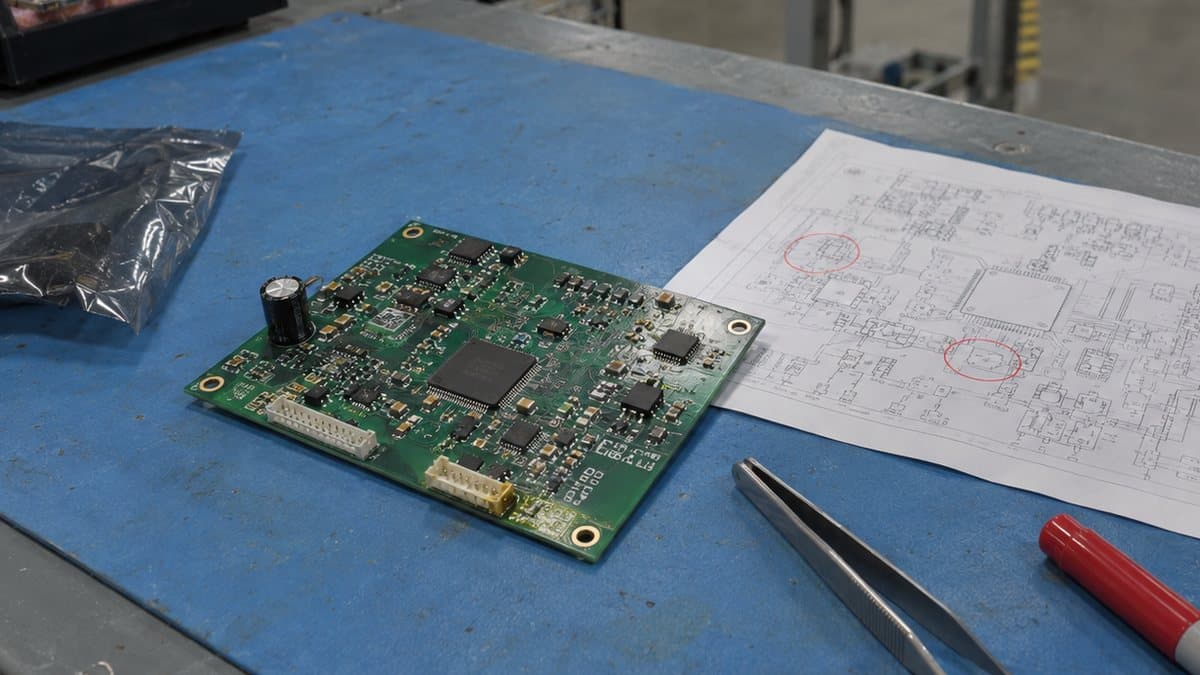
Mining control electronics need two kinds of reliability: they must survive the machine, and in gassy underground mines they must also stay permissible. Survival means building to IPC-A-610 Class 3, hardening boards with conformal coating and staking, and proving them with IEC 60068 vibration and shock tests, an IEC 60529 enclosure rating, and ISO 13766 EMC testing for mobile machines. Permissibility means equipment approved by MSHA under 30 CFR Part 18, often using two-fault intrinsic safety, and built exactly to the approved drawings, because MSHA must concur before any approved feature changes. For export, IEC 60079-11 and IECEx certification play the same role.
This guide is for engineers and sourcing leads at OEMs that build drills, loaders, haul trucks, ventilation and monitoring systems, and other mining equipment. It covers why mining is unusually hard on electronics, which standards apply to what, and what to require from the contract manufacturer that builds your boards.
Why mining is harder on electronics than most industrial work
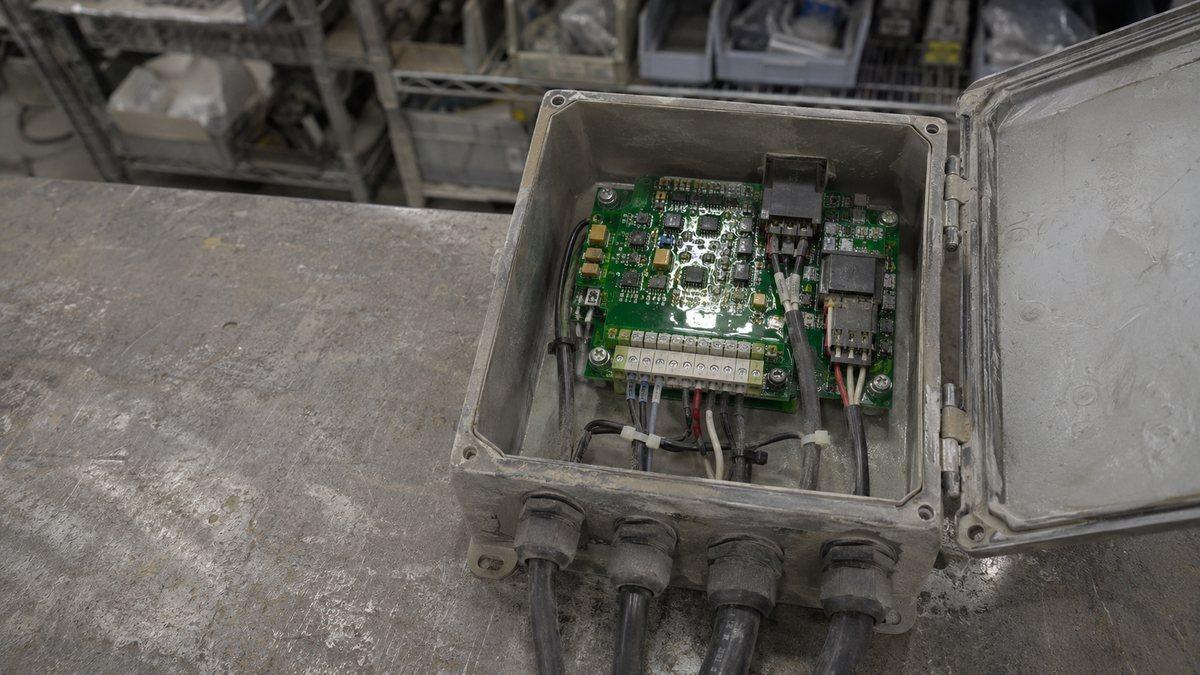
A control board on a mining machine sees almost every stressor at once. Continuous vibration from engines, crushers and rough haul roads fatigues solder joints and component leads. Shock loads from drilling, blasting and bucket impacts crack ceramic capacitors and loosen connectors. Fine dust, some of it conductive or corrosive, settles on assemblies and holds moisture against the board. Water from dust suppression, washdown and groundwater finds every unsealed gap. Temperature swings between a hot engine bay and a cold ventilation drift drive solder fatigue, and large motors and variable-frequency drives create electrical noise that can upset sensitive control circuits.
Underground coal and other gassy mines add a hazard that most industrial electronics never face: methane and coal dust can form an explosive atmosphere, and a spark or hot component can ignite it. That is why electronics for those areas are regulated as safety equipment, not just as industrial controls.
The standards that apply to mining control electronics
No single standard covers a mining PCBA. Each one below answers a different question, and most mining programs need several of them.
- MSHA 30 CFR Part 18: U.S. approval of electric motor-driven equipment and accessories for use where permissible equipment is required in gassy underground mines. It covers explosion-proof enclosures and intrinsically safe circuits.
- IEC 60079-0 and IEC 60079-11: the international explosive-atmosphere standards. Group I covers mines, and IEC 60079-11 defines intrinsic-safety protection, with IECEx as the international certification scheme.
- ISO 19296: machine safety for self-propelled mobile machines working underground. It does not cover explosive-atmosphere risks, which stay with Part 18 or IEC 60079.
- ISO 13766-1 and -2: electromagnetic compatibility test methods and acceptance criteria for earth-moving machinery, including the functional-safety side of EMC.
- ISO 13849-1: design of safety-related parts of control systems, such as interlocks and emergency stops.
- IEC 60068 and IEC 60529: environmental test methods for vibration, shock and temperature, and enclosure ingress protection ratings.
- IPC-A-610 Class 3, J-STD-001 and IPC-CC-830: the workmanship, soldering and conformal-coating standards that decide whether the assembly itself is built for high reliability.
Mining control electronics: questions answered
What does "permissible" mean for mining electronics?
Permissible equipment has been approved by MSHA as safe to operate where an explosive methane-air mixture or coal dust may be present. Under 30 CFR Part 18, an approval covers a complete machine or accessory as documented in its approved drawings and specifications. Electronics inside that equipment are typically protected either by explosion-proof enclosures or by intrinsically safe circuits that cannot release enough energy to ignite the atmosphere.
Who holds the MSHA approval: the OEM or the contract manufacturer?
The approval belongs to the applicant, normally the OEM that designs and sells the equipment. A contract manufacturer builds to the approved documentation. That makes change control critical: 30 CFR 18.15 requires MSHA's concurrence before any feature of approved equipment is changed, through an application to extend the approval. A substituted component or a revised layout that seems harmless can put permissibility at risk, so your manufacturer should hold any such change until you approve it.
What is intrinsic safety, and why does the two-fault rule matter for PCB layout?
Intrinsic safety limits the electrical and thermal energy a circuit can release so it cannot ignite an explosive atmosphere, even when components fail. MSHA's Part 18 approvals call for intrinsic safety that holds with two faults, comparable to protection level "ia" in IEC 60079-11. On the board, that rests on specific energy-limiting components, required spacing between intrinsically safe and other circuits, and creepage and clearance distances that the certified design depends on. Those details are fixed in the approved drawings, so the assembly must reproduce them exactly.
How do Group I equipment protection levels Ma and Mb differ?
In the IEC 60079 system, Group I equipment is intended for mines susceptible to firedamp. Equipment protection level Ma provides a very high level of protection and can stay energized when an explosive atmosphere is present. Level Mb provides a high level of protection and is intended to be de-energized when gas is detected. Exporters typically certify through the IECEx scheme or regional equivalents, and the protection level chosen drives how the electronics are designed and built.
Does conformal coating matter for mining PCBAs?
Yes, and for two reasons. In any mining environment, coating protects against moisture, dust and corrosion, as covered in our conformal coating comparison. In intrinsically safe designs it can also be part of the certified design, because IEC 60079-11 allows certain separation distances to be measured under a qualifying coating. In that case the coating material, coverage and masking are certification requirements, not finishing choices, and they must match the approved drawings.
Which vibration and shock tests should mining electronics pass?
Most programs use IEC 60068 methods: 60068-2-6 for sinusoidal vibration, 60068-2-64 for broadband random vibration, and 60068-2-27 for shock. The standards define how to test, not how hard, so the severity should come from the machine's own vibration profile and mounting location. A board on an engine-mounted controller needs a far harsher profile than one in an operator cab. We cover tailoring these tests in more depth in our guide to hardening industrial electronics for harsh environments.
What EMC standard applies to mobile mining machines?
For machines that fall under the earth-moving machinery definition, such as loaders, dozers and haul trucks, ISO 13766-1 provides EMC test methods and acceptance criteria, and ISO 13766-2 covers EMC for functional safety. Large drives, radios and long cable runs make EMC a real reliability issue on these machines, so filtering, grounding and shielding decisions in the design need to be built consistently on every unit.
Common mistakes in mining electronics programs
- Treating an approved design as editable. Swapping an obsolete part or tweaking a layout without going back through the approval process can compromise permissibility.
- Specifying Class 2 workmanship for a Class 3 environment. Machine-mounted controls in mining see sustained vibration and contamination; IPC-A-610 Class 3 acceptance criteria exist for exactly that.
- Testing at the wrong severity. IEC 60068 defines methods, not levels. Borrowing a profile from another application can pass boards that fail in the field.
- Relying on coating for mechanical support. A thin conformal coat does not hold heavy components against vibration; staking, bonding or potting does.
- Losing traceability. When a field failure happens on a safety-related control, you need component lot, date-code and inspection records to scope it quickly.
How i-TECH e-Services builds mining and heavy-equipment electronics
i-TECH e-Services is a U.S. contract manufacturer in Norcross, Georgia, building industrial electronics and energy and utility hardware alongside aerospace, defense and medical work. We build to your released documentation and do not hold MSHA approvals or IECEx certificates for customer products: those belong to you as the OEM. What we provide is a disciplined build that protects them.
- Class 3 assembly. Boards are soldered to J-STD-001 and inspected to IPC-A-610 Class 3, under an AS9100D and ISO 13485:2016 quality management system with component traceability.
- Hardening on the line. Selective conformal coating on an SCS PrecisionCoat V with masked connectors and test points, plus component staking and bonding, and BGA rework on Air-Vac equipment.
- Inspection and test. 3D AOI (Parmi), X-ray (Glenbrook) for hidden joints, SPEA flying-probe test, and functional test, detailed under quality and testing.
- The rest of the assembly. Box build and enclosure integration and cable and wire-harness assembly to IPC/WHMA-A-620, so sealed connectors and strain relief are built as carefully as the boards.
Environmental qualification and explosive-atmosphere certification are run by your accredited test lab and certification body; we support those programs rather than replacing them. To scope a mining or heavy-equipment build, contact our engineering team.
Bottom line
Mining control electronics fail in predictable ways, and the standards map onto them directly: IPC-A-610 Class 3 and coating for the build, IEC 60068 and IEC 60529 for the environment, ISO 13766 for EMC on mobile machines, and MSHA 30 CFR Part 18 or IEC 60079 for anything that runs where gas may be present. Design to the real duty cycle, certify what the mine requires, and choose a manufacturer whose change control keeps every unit identical to the design you approved.